


Mining and heavy industrial operations are built around long lifecycle equipment. Crushers, conveyors, pumps, structural frames, and processing systems often remain in service for decades. However, OEM support rarely matches that lifespan.
When manufacturers discontinue components, operations face a critical decision. Wait and risk extended downtime, or reverse engineer obsolete parts and restore control immediately.
With modern digital workflows and industrial 3D scanning for legacy parts, it is now possible to recreate discontinued components with engineering precision. Obsolete heavy equipment parts reverse engineering is no longer a last resort. It is a strategic advantage.
The Growing Problem of Obsolete Heavy Equipment Parts
OEM discontinuation is common in heavy equipment manufacturing. As models evolve, support for older systems gradually fades.
Why OEMs Stop Supplying Parts
Typical reasons include:
- Product lifecycle termination
- Model redesigns
- Material supply changes
- Low demand for legacy components
- Global supply chain restructuring
For operations running legacy fleets, this creates operational vulnerability.
The True Cost of Obsolete Components
When a critical part is no longer available, the consequences include:
- Unexpected production shutdown
- Extended lead times
- Expensive international sourcing
- Temporary fixes that compromise reliability
In mining environments, a single failed component can halt entire production lines.
This is where obsolete heavy equipment parts reverse engineering becomes essential.
What It Means to Reverse Engineer Obsolete Parts
To reverse engineer obsolete parts means to digitally capture, reconstruct, and reproduce a discontinued component using engineering validation.
This process relies heavily on industrial 3D scanning for legacy parts to ensure dimensional accuracy.
The Technical Definition
The workflow includes:
- Performing industrial 3D scanning for legacy parts
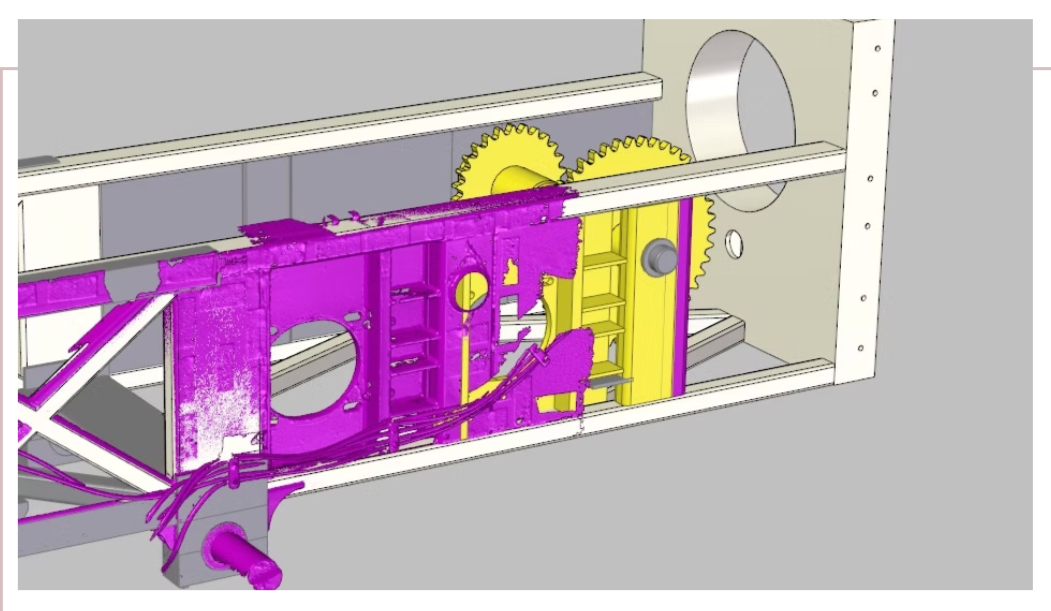
- Generating a precise point cloud
- Converting scan data into a detailed CAD model
- Engineering review and tolerance correction
- Manufacturing a validated replacement
The objective is not to copy defects, but to restore or improve original performance.
Why Reverse Engineering Is Superior to Improvised Fabrication
Improvised fabrication often relies on partial measurements or assumptions. Reverse engineering obsolete parts uses full surface data and engineering oversight to ensure:
- Proper fit
- Correct tolerances
- Structural integrity
- Long term reliability
This approach significantly reduces the risk of repeat failures.
The Role of Industrial 3D Scanning for Legacy Parts
Industrial 3D scanning for legacy parts is the backbone of modern reverse engineering.
Heavy machinery components are rarely simple shapes. They often contain:
- Complex cast geometries
- Curved surfaces
- Internal cavities
- Irregular wear patterns
Traditional measurement tools cannot capture these accurately.
How Industrial 3D Scanning for Legacy Parts Works
The process includes:
- Laser or structured light scanning
- Capturing millions of surface data points
- Generating high resolution digital geometry
- Creating a fully editable CAD model
This digital model forms the basis for obsolete heavy equipment parts reverse engineering.
Why Precision Matters in Heavy Industry
Mining and industrial machinery operate under extreme conditions:
- High load
- Abrasive materials
- Continuous vibration
- Thermal stress
Even minor dimensional inaccuracies can cause:
- Premature wear
- Misalignment
- Bearing failure
- Structural fatigue
When you reverse engineer obsolete parts using industrial 3D scanning for legacy parts, precision is controlled and documented.
For a broader look at digital capture technology, explore our guide on 3D scanning heavy equipment.
Start with our 3D scanning heavy equipment and reverse engineering guide to understand the full digital workflow from scan to finished part.
Step by Step Process to Reverse Engineer Obsolete Parts
A structured workflow ensures consistency and reliability.
Step 1 3D Scanning the Component
The obsolete component is scanned in controlled conditions. Surface preparation may be performed to improve scan clarity.
Step 2 Digital Reconstruction
The point cloud is processed and converted into a parametric CAD model. Engineers reconstruct missing or damaged geometry.
Step 3 Engineering Validation
Critical checks include:
- Dimensional accuracy
- Load bearing analysis
- Material compatibility
- Wear compensation
This stage distinguishes professional obsolete heavy equipment parts reverse engineering from simple duplication.
Step 4 Manufacturing and Inspection
The validated design is manufactured using appropriate methods such as machining, casting, or fabrication.
Quality control verifies:
- Tolerance compliance
- Surface finish
- Structural integrity
Step 5 Installation and Performance Monitoring
After installation, performance is monitored to confirm correct alignment and functionality.
Common Applications in Mining and Heavy Industry
Reverse engineering obsolete parts applies across a wide range of equipment.
Crusher Components
- Housings
- Mounting plates
- Support frames
Pump Assemblies
- Casings
- Flanges
- Sealing surfaces
Structural Fabrications
- Conveyor supports
- Chute components
- Reinforcement brackets
Hydraulic Interfaces
- Couplings
- Adaptors
- Mounting brackets
In all cases, industrial 3D scanning for legacy parts ensures precise geometry before manufacturing.
Benefits of Obsolete Heavy Equipment Parts Reverse Engineering
Companies choose to reverse engineer obsolete parts because the advantages are measurable.
Reduced Downtime
Local digital capture and production reduce waiting time for unavailable OEM components.
Faster Lead Times
Engineering workflows accelerate validation and manufacturing.
Lower Total Operational Risk
By avoiding temporary fixes, companies reduce long term failure risk.
Improved Component Performance
Reverse engineering often allows for:
- Stronger materials
- Enhanced structural design
- Improved wear resistance
This transforms a replacement into a performance upgrade.
For examples focused on urgent failures, read reverse engineering critical components to reduce downtime with custom parts.
Why Millennium Machinery Is the Trusted Partner
Recreating discontinued components requires more than scanning technology. It requires deep understanding of heavy industrial systems.
Millennium Machinery combines:
- Industrial 3D scanning for legacy parts
- Obsolete heavy equipment parts reverse engineering expertise
- Manufacturing coordination
- Technical service experience
This integrated capability ensures that when you reverse engineer obsolete parts, the result is production ready and performance validated.
Key advantages include:
- Experience in mining and heavy industrial sectors
- Rapid response for urgent breakdowns
- Ability to move from scan to finished part
- Regional and international project support
Millennium Machinery does not simply deliver digital files. It delivers engineered solutions.
Frequently Asked Questions
Can you reverse engineer obsolete parts if they are severely worn?
Yes. Engineers use surface reconstruction techniques to rebuild original geometry even when wear is significant.
How accurate is industrial 3D scanning for legacy parts?
Industrial scanning systems capture high resolution surface data suitable for precision machining and structural components.
Is obsolete heavy equipment parts reverse engineering cost effective?
When downtime, shipping delays, and production loss are considered, reverse engineering is often the most economical solution.
How long does it take to reverse engineer obsolete parts?
Timelines vary by complexity, but digital workflows significantly reduce overall project duration compared to sourcing discontinued parts.
Can improvements be made during reverse engineering?
Yes. Engineers can enhance material selection and structural design for improved durability.
When the OEM Stops Supplying, Take Control
Discontinued components do not have to stop production.
By choosing to reverse engineer obsolete parts using industrial 3D scanning for legacy parts, companies regain:
- Control over maintenance timelines
- Confidence in part quality
- Independence from OEM discontinuation
- Improved long term asset reliability
Millennium Machinery provides complete obsolete heavy equipment parts reverse engineering solutions tailored to mining and heavy industrial operations.
If your OEM no longer supplies a critical component, contact Millennium Machinery today to evaluate your part and develop a precise, engineered replacement solution.