


Choosing the right rock drill bit is essential for efficient drilling in mining and quarrying operations. Different rock formations, drilling methods, and equipment configurations require different bit designs. A poorly matched bit can reduce penetration rates, increase wear, and lead to unnecessary equipment downtime.
The main rock drill bit types include button bits, cross bits, chisel bits, and specialized down-the-hole (DTH) bits. The best choice depends on rock hardness, abrasiveness, hole diameter, drilling depth, and whether the operation uses top hammer or DTH drilling.
Understanding these differences helps operators improve drilling productivity and manage consumable costs.
What Are Rock Drill Bits?
Rock drill bits are cutting tools designed to fracture and penetrate rock during drilling. They transfer impact energy, rotation, and thrust from drilling equipment to the rock formation.
Unlike general-purpose construction drill bits, industrial rock drilling tools are engineered for demanding applications such as:
- Surface mining and quarry production
- Blast-hole drilling
- Underground mining
- Rock excavation and construction
- Exploration and geotechnical drilling
- Infrastructure and foundation projects
The drill bit is part of a larger drilling system that may include drill rods, shank adapters, couplings, and hydraulic or pneumatic drilling equipment.
Operators using equipment from manufacturers such as Epiroc can explore available drilling solutions through an Epiroc authorized dealer to identify components suited to their application.
Common Types of Rock Drill Bits
Different bit designs affect penetration, hole accuracy, wear resistance, and overall drilling performance.
1. Button Drill Bits
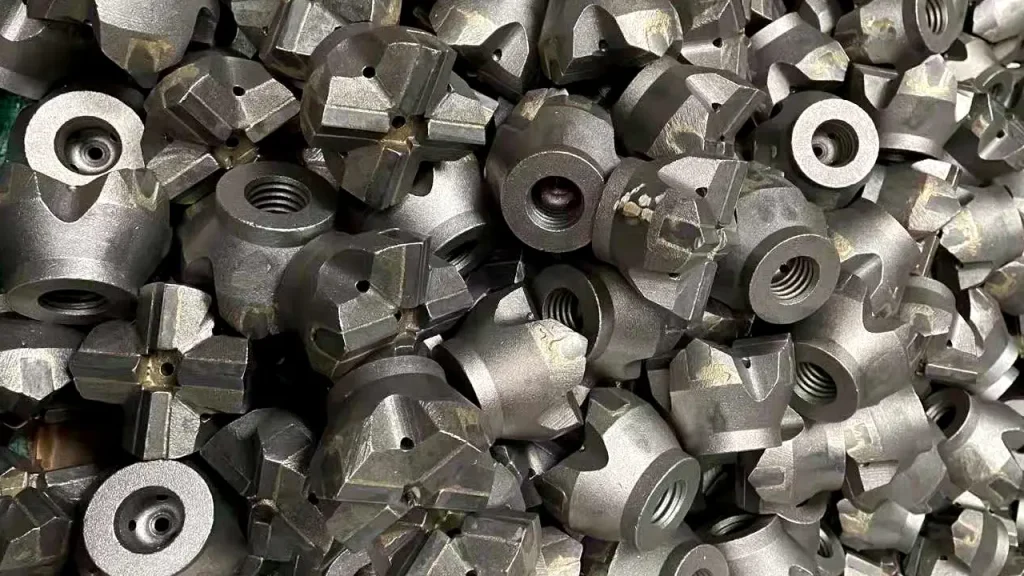
Button bits are widely used in mining and quarrying because they provide durable rock-breaking performance across a range of formations.
These bits use tungsten carbide inserts, called buttons, to fracture rock under repeated impact.
Two common button shapes are:
Spherical buttons: Rounded inserts that generally offer durability and resistance to insert breakage in demanding drilling conditions.
Ballistic buttons: More pointed inserts that can improve penetration in suitable formations but may require closer attention to wear and damage.
Button bits are frequently used for production drilling, blast holes, and hard-rock applications.
The ideal button profile depends on formation properties and the bit manufacturer’s recommendations.
2. Cross Drill Bits
Cross bits feature carbide cutting inserts arranged in a cross-shaped configuration.
They are commonly associated with percussive rock drilling systems and can be useful in certain softer to medium-hard rock formations.
Their relatively simple cutting geometry can make them suitable for particular drilling conditions, although their performance in highly abrasive or fractured rock must be assessed carefully.
Before selecting a cross bit, verify its suitability for the rock drill, connection type, and hole requirements.
3. Chisel Drill Bits
Chisel bits have a straight cutting edge and are commonly associated with smaller-diameter rock drilling applications.
They may be used with compatible handheld or pneumatic rock drills for construction, quarrying, and general rock excavation.
Their suitability depends on the drilling system and rock formation. They are not interchangeable with button bits simply because the nominal hole diameter is similar.
4. Tapered Drill Bits
Tapered drill bits connect to matching tapered drill steel and are often used with lighter percussive drilling equipment.
They are available with different cutting-face designs, including button, cross, and chisel configurations.
Typical applications include:
- Small-scale quarry drilling
- Secondary rock breaking
- Construction-site drilling
- Short-hole rock excavation
When purchasing tapered drill bits, confirm the taper angle, shank compatibility, diameter, and drilling application.
A mismatch between the bit and drill steel can affect connection reliability and drilling performance.
5. DTH Drill Bits
Down-the-hole drilling places the hammer near the bottom of the hole, directly behind the bit.
DTH hammer bits are designed to work with specific hammer systems and typically feature carbide buttons and flushing passages.
They are commonly used where operators need consistent hole quality and effective drilling at greater depths.
DTH drilling may be particularly suitable for quarry blast holes, certain mining applications, and other projects requiring deep, relatively straight holes.
However, bit selection must account for hammer compatibility, air requirements, rock conditions, and drilling objectives.
Top Hammer vs. DTH Drilling: What’s the Difference?
The drilling method determines which bit and related components can be used.
| Feature | Top Hammer Drilling | DTH Drilling |
|---|---|---|
| Impact mechanism | Hammer at the top of the drill string | Hammer positioned behind the bit |
| Typical application | Bench drilling and many shorter-hole applications | Deeper-hole and production drilling |
| Bit connection | Compatible threaded or other system-specific connections | Hammer-specific bit shank |
| Energy delivery | Impact energy travels through drill steel | Impact energy acts near the hole bottom |
| Selection factors | Rods, couplings, bit design, hole diameter | Hammer type, air supply, bit diameter |
Neither system is universally superior.
For example, a quarry may choose top hammer drilling for certain bench configurations, while a deeper-hole operation may find DTH equipment more appropriate.
The final decision should consider productivity, drilling depth, hole diameter, formation conditions, and the cost per drilled foot.
For additional equipment guidance, read MMPAS’s Epiroc drill rig maintenance guide to understand how maintenance affects drilling reliability.
How to Choose the Right Rock Drill Bit
Evaluate Rock Hardness and Abrasiveness
Hardness determines how resistant the rock is to penetration, while abrasiveness affects how quickly the cutting surfaces wear.
A hard, abrasive formation may require a different button geometry and carbide grade than a comparatively soft limestone deposit.
Rock structure also matters. Fractured formations can create different drilling challenges than homogeneous rock.
Match the Bit to Your Drilling Equipment
The bit must be compatible with the drilling system.
Check:
- Drill rig and hammer model
- Bit connection or shank type
- Required hole diameter
- Recommended operating parameters
- Drill steel and coupling compatibility
- Flushing requirements
For multi-machine fleets, maintaining accurate equipment and part records helps prevent incorrect orders.
MMPAS also explains the importance of verifying equipment details in its guide to ordering mining replacement parts correctly.
Consider Hole Diameter and Depth
Hole dimensions influence bit size and drilling method.
Larger or deeper holes may require different drilling systems, depending on the application. Selection should follow equipment capabilities and the blasting or engineering plan.
Compare Cost per Drilled Foot
The cheapest drill bit is not necessarily the most economical.
Consider bit purchase price alongside penetration rate, bit life, downtime, and the labor involved in changing tools.
A useful performance measure is:
Consumable cost per drilled foot = Total bit expenditure ÷ Total footage drilled
For example, if a bit costs $300 and drills 600 feet before replacement, its bit-only cost is $0.50 per foot.
This illustrative calculation excludes labor, fuel, machinery ownership, and other drilling costs.
Review Spare Parts Availability
A bit that performs well but is difficult to replace can create supply-chain problems.
Working with an experienced mining spare and wear parts supplier can help operators identify compatible components and plan replacement inventory.
Need Help Selecting Rock Drilling Equipment?
Avoid ordering incompatible components or losing drilling time to incorrect specifications.
Request Rock Drilling Parts & Equipment Support
Share your drill model, application, hole diameter, and rock conditions with the MMPAS team to discuss suitable sourcing options.
Signs Your Rock Drill Bit Needs Replacement
An excessively worn bit can reduce penetration and increase drilling costs.
Watch for:
- A sustained decline in penetration rate under comparable conditions
- Cracked, chipped, or missing carbide buttons
- Excessive wear on the bit body or gauge
- Damaged flushing passages
- Irregular hole quality
- Abnormal vibration or repeated drilling interruptions
Some button bits can be reground within the manufacturer’s specified wear limits. Others must be replaced.
Continuing to operate damaged tools can affect the drill string and connected equipment.
If declining drilling performance persists after inspecting the consumables, use the Epiroc drill rig troubleshooting guide to review other possible equipment-related causes.
Why Equipment and Parts Compatibility Matters
Drilling performance depends on more than the bit itself.
The hammer, drill rods, flushing system, and machine operating parameters must work together.
Mismatched components can increase vibration, accelerate wear, or reduce operational efficiency.
MMPAS provides equipment sourcing and technical support for mining and construction applications. Its equipment repair and service solutions can also help operations address broader machinery problems affecting uptime.
Frequently Asked Questions About Rock Drill Bits
What type of drill bit is best for hard rock?
Carbide button bits are commonly used for hard-rock drilling. The appropriate button shape, carbide grade, and drilling system depend on the rock’s abrasiveness, structure, and the equipment being used.
What is the difference between a button bit and a DTH bit?
A button bit describes a cutting-face design, while a DTH bit is designed to work with a down-the-hole hammer. Many DTH bits use carbide buttons, so the terms are not mutually exclusive.
How long does a rock drill bit last?
Bit life depends on rock abrasiveness, drilling method, operating pressure, maintenance, and bit quality. Operators should track drilled footage and inspect wear rather than rely on a universal replacement interval.
What is the difference between top hammer and DTH drilling?
Top hammer drilling delivers impact energy from a hammer near the top of the drill string. DTH drilling places the impact mechanism directly behind the bit near the bottom of the hole.
Can the same rock drill bit be used on different rigs?
Only when the bit’s connection, dimensions, operating requirements, and intended application are compatible with the equipment. Always verify manufacturer specifications.
How do I know when to replace a rock drill bit?
Reduced penetration, damaged carbide buttons, excessive gauge wear, and deteriorating hole quality are common warning signs. Replacement decisions should follow the manufacturer’s wear criteria.
Find the Right Rock Drilling Solution With MMPAS
Selecting the right rock drill bit can improve drilling consistency, reduce unnecessary tool wear, and help operators manage downtime.
Millennium Machinery Parts & Service supports mining, quarrying, and construction businesses with drilling equipment sourcing, replacement parts, and technical assistance.
Whether you need compatible drilling tools or broader machinery support, MMPAS can help you evaluate available solutions.